From Gaming Room to Destination Entertainment
Casino destination entertainment history explains how gaming venues became wider leisure destinations, while showing why Hóc Môn’s urban context is distinct.
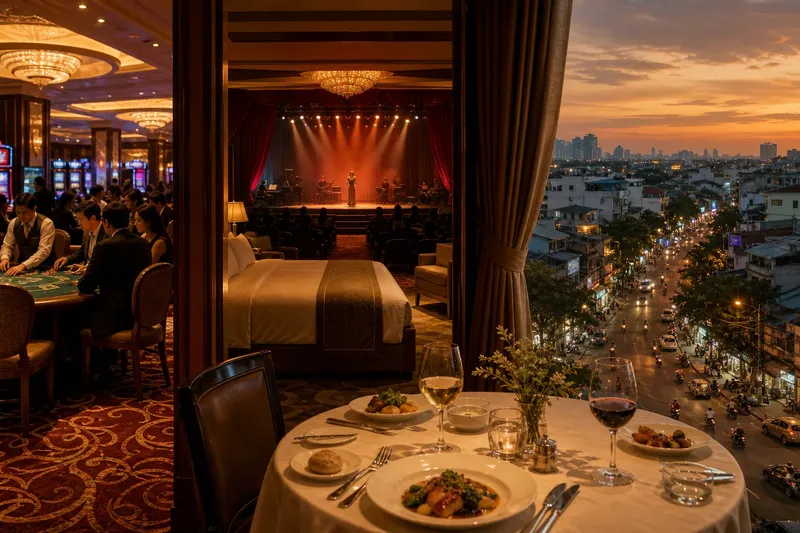
The common mistake in casino destination entertainment history is to treat the resort as the beginning of the story. That obscures the more useful question: how did particular venues bring gaming together with dining, lodging and live entertainment? Hóc Môn offers a city-scale contrast, not evidence of a local casino history.
Different venue histories
There is no single origin date for the casino resort as a format. Casinos developed in different legal, commercial and urban settings, and the available account here does not support a dated chronology or named venue-by-venue history. It is more accurate to describe the change as a shift in organisation at some places, rather than a universal sequence.
A gaming-led venue centres its offer on play. Visitors might arrange meals, accommodation or other entertainment separately. A broader destination brings some of those activities together, so guests can plan a longer visit around several attractions. These are useful descriptions of emphasis, not fixed categories: venues can combine elements in different ways.
Leisure under one roof
When a venue includes a restaurant or performance space, the visit can be planned around more than gaming. Accommodation changes the offer again: it allows the venue to present itself as a place to stay, not only somewhere to spend an evening. The significance lies in that packaging of activities; it does not establish that every casino followed the same path.
A resort may group its facilities in one building or across a managed district. A casino with a restaurant but no lodging has a broader offer than a gaming-only room, yet that alone does not make it a resort. The label describes a bundled leisure proposition, and its meaning can vary between places.
Hóc Môn’s urban scale
Hóc Môn is useful here as a geographic point of comparison within the wider Ho Chi Minh City area. A neighbourhood is part of a larger urban fabric: destinations, services and leisure spaces may be dispersed rather than gathered in one managed complex. That contrast concerns scale and organisation, not a claim that Hóc Môn has a casino resort or a particular casino history.
Imagine a visitor starting in Hóc Môn with an evening show as the main plan and a meal as an optional extra. They check the event listing, choose a performance venue, then decide to eat nearby rather than seek a single complex containing both activities. The observable outcome is an evening arranged across separate city locations; the decision differs from choosing a destination designed to bundle the programme in one place.
How should the terms be read?
Does every casino become a resort?
No. A venue may remain centred on gaming, add a dining room or offer entertainment without adopting a resort model. The term is best reserved for a broader, organised leisure offer.
What distinguishes a casino resort?
It combines gaming with other visitor activities, commonly including food, entertainment or lodging, within one venue or a managed district. The combination and scale vary, so the label does not describe one standard design.
Why use Hóc Môn as a comparison?
It helps distinguish a neighbourhood within a wider city from a purpose-organised destination. That is a geographic comparison, not evidence about casinos in Hóc Môn.
Can this history be dated precisely?
Not from the evidence available for this account. Without named venues and reliable dates, a precise timeline would imply more certainty than the subject supports.
Images and expectations
Films, advertisements and travel writing often present casino destinations through familiar scenes: gaming tables, a stage and a grand dining room. Such images can make the bundled leisure offer easy to recognise, but they are not a historical timeline. To understand a venue’s actual form, look at what it provides and how those activities are arranged, rather than relying on a cinematic image.
Casino destination entertainment history is therefore best read as a varied story of venue design, not a march towards one inevitable model. The distinction also keeps the comparison with Hóc Môn in proportion: a resort gathers activities by design, while urban leisure can be distributed across the city and connected by ordinary journeys.